Artificial intelligence has made it possible for almost any business to create a 2,000-word article about almost any subject in a matter of minutes. That is an extraordinary advancement for businesses that previously lacked the time or resources to maintain a meaningful content strategy, but it also creates a new marketing problem: when everyone can produce content quickly and inexpensively, simply producing more of it is no longer a significant competitive advantage.
Consider five competing pool builders using AI to write an article about the benefits of installing a custom swimming pool. Each article will probably be reasonably well written. They will likely discuss entertaining, exercise, property value, customization and creating a backyard retreat. The information may be accurate and useful, but there is a more important question to ask: What does any of it tell a homeowner that couldn't also be learned from Google, ChatGPT or the other four pool builders?
That is the content challenge businesses are beginning to face in the age of AI.
For years, digital marketing rewarded businesses that consistently created useful content around the subjects their customers searched for. Marketers researched keywords and search intent, identified topics, created articles and service pages, optimized them for search and worked to improve their rankings. Those fundamentals haven't suddenly become irrelevant, but AI has made one part of that process remarkably easy: creating the words.
When something becomes easier for everyone to produce, the source of competitive advantage usually shifts elsewhere. In content marketing, we believe that advantage increasingly lies in what the business actually knows.
We've Been Working Our Way Toward This Question
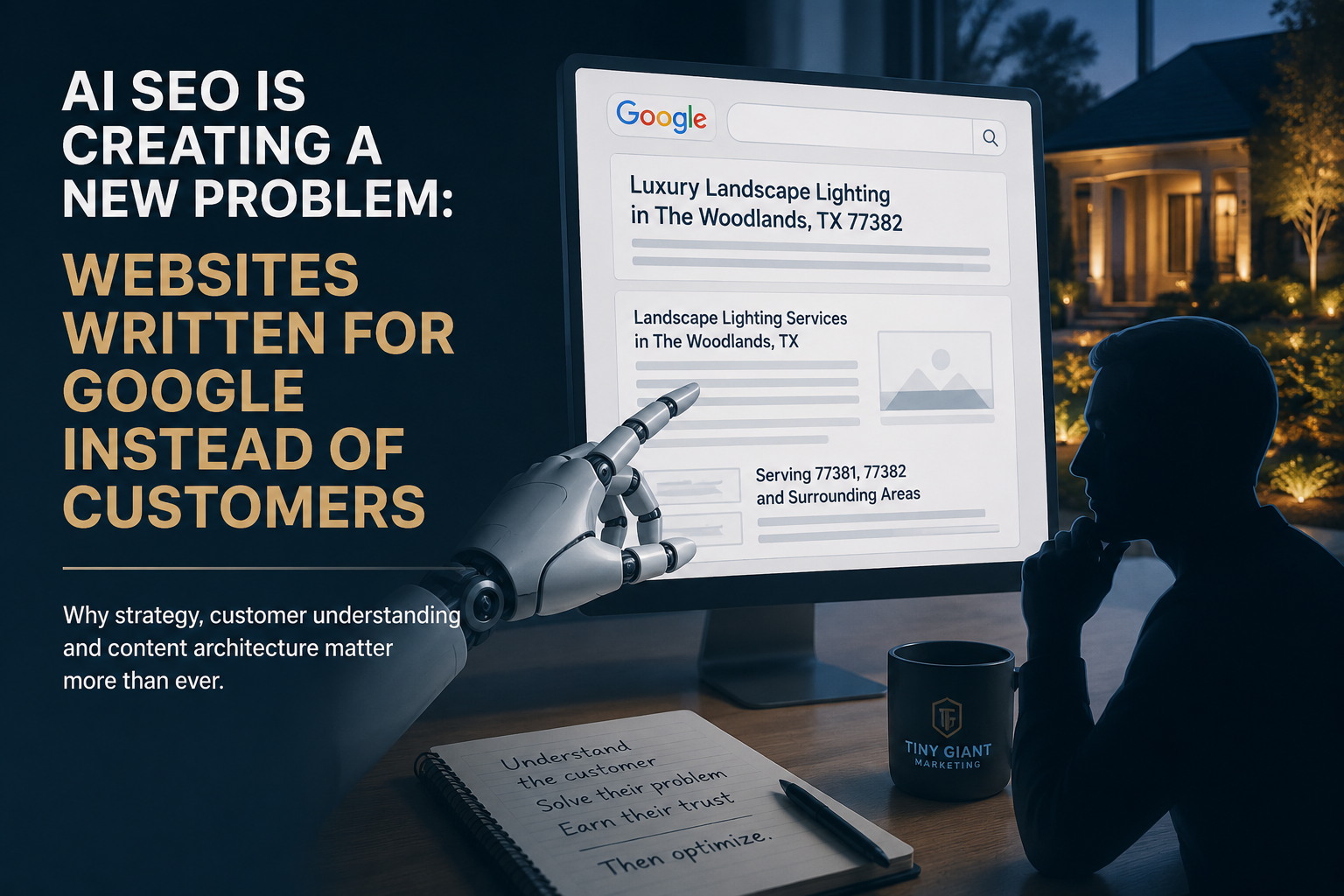
In our earlier article, "AI SEO Is Creating a New Problem: Websites Written for Google Instead of Customers," we examined what happens when businesses become so focused on satisfying search engines that they lose sight of the person who eventually arrives at the website. Search visibility can earn a business the opportunity to be considered, but ranking well doesn't automatically give a customer a reason to choose one company over another.
We continued that discussion in "Your Keywords Aren't Your Customer: Why Customer Vernacular Matters More in the Age of AI," where we looked at the limitations of treating keyword research as customer research. A keyword can tell us what someone typed into a search box, but it doesn't necessarily explain why the search occurred, what prompted it, what concerns the person has, how they describe the problem in everyday conversation or what they need to understand before making a decision.
That distinction is why we believe customer personas should extend well beyond demographics. Understanding the customer's questions, motivations, concerns, vernacular and decision process helps us move from simply asking what did this person search for? to the more useful question of what are they actually trying to understand?
There is, however, another step in that progression.
Once we understand the customer's question, what are we going to tell them that they can't get from everybody else?
That question has always mattered in marketing, but the rapid growth of AI-generated content makes it increasingly difficult to ignore.
AI Has Changed the Economics of Content
There was a time when creating a substantial library of useful website content required considerable resources. Research had to be conducted, articles written and edited, pages optimized, and everything ultimately published and maintained. For a small or midsize business, the time and expense involved often limited how much meaningful content it could realistically produce.
AI has dramatically lowered that barrier. A business can now create first drafts of service pages, location pages, FAQs, blog articles, social content and email campaigns at a speed that would have been difficult to imagine only a few years ago. Used responsibly, that efficiency allows marketers and business owners to spend less time staring at a blank page and more time researching, evaluating and improving the information being communicated.
The consequence, however, is that content itself is becoming less scarce. If your competitors have access to the same tools, they can produce another article about "five signs you need a new water heater" just as quickly as you can. They can create another page explaining the benefits of landscape lighting, another guide to choosing a property management company or another article about designing an outdoor kitchen.
The ability to produce content is no longer necessarily what separates one business from another. What remains much more difficult to replicate is the knowledge a business has accumulated through years of actually serving customers.
AI can explain what a patio cover is, but it doesn't automatically know which questions Houston homeowners repeatedly ask before deciding whether to build one. It can explain LED lighting, but it doesn't inherently know what confuses customers when they are standing in a lighting showroom comparing fixtures. It can explain property management, but it doesn't know which concerns property owners consistently raise during their first conversation about replacing an existing management company.
Those distinctions matter because they move us away from simply publishing information and toward answering the questions that actually influence customer decisions.
The Best Content May Already Be Inside Your Company
Much of the knowledge that could make a company's content more useful never begins as "content." It exists in everyday conversations throughout the business.
A salesperson who has spoken with hundreds of prospects knows which objections repeatedly arise before someone is comfortable moving forward. A technician recognizes when customers describe symptoms incorrectly and knows which questions uncover the real problem. A project manager sees which decisions homeowners tend to underestimate until construction begins. An estimator knows which questions almost always follow a proposal. A showroom employee hears the terminology customers actually use when they don't know the industry's vocabulary.
The same information can be found outside the company. Customer reviews reveal what people valued enough to mention after doing business with you. Emails contain questions that may never have occurred to anyone creating the website. Sales calls expose recurring concerns, misunderstandings and comparisons. Even lost opportunities can tell a business something about what customers needed to understand but perhaps never did.
All of this is potential marketing material, but calling it "content" too early can cause us to miss its real value. Before it becomes an article, FAQ, service page or video, it is business knowledge. The marketing opportunity is to identify that knowledge, understand where it intersects with customer questions and search intent, and then determine the best way to communicate it.
AI can play an important role in that process, but it shouldn't be expected to invent the underlying experience.
What Does Your Business Know That AI Doesn't?
A recent MarketingSherpa article based on MECLABS thinking, "Three Cuts That Can Get Your Company Marketing Lifts," provides an interesting example of this shift. Among the cases discussed is a software company that reduced its emphasis on generic top-of-funnel content—the types of informational articles that AI and countless other websites could already answer reasonably well—and focused more attention on information drawn from its actual market experience.
That included competitive differences, questions prospects were genuinely asking, product distinctions and information that helped buyers evaluate their options. The lesson isn't that informational content no longer has a place. Rather, it raises a more useful question about where businesses should invest their content resources when generic information has become so inexpensive to produce.
A patio contractor still needs to explain patio covers. A plumber still needs pages explaining water heater repair. A lighting showroom needs information about the fixtures, fans and lighting solutions it provides. Those pages help customers orient themselves, help search engines understand the business and increasingly provide AI search systems with factual information they can retrieve and interpret.
The problem occurs when that is where the content stops.
If a business publishes essentially the same explanation that already exists on hundreds of other websites, it may have created a technically appropriate SEO page without contributing much that helps a customer understand why this particular company deserves consideration.
The better question is: What can this business add to the conversation based on what it has actually experienced?
Moving From Search Intent to the Knowledge Gap
Search intent remains an essential part of developing effective SEO content. If someone searches for "screened patio Houston," we need to understand what Google interprets that search to mean, what types of results satisfy it and what information the person is likely seeking.
But keyword research alone can't tell us the entire story.
A homeowner making that search might be tired of mosquitoes making the patio unusable in the evening. Another may have a west-facing patio that becomes uncomfortable in the afternoon. Someone else may already have a covered patio and be trying to determine whether the existing structure can be screened. Another homeowner may be comparing different screen materials and wondering how much sunlight or visibility they will lose.
The keyword is the same. The questions behind it can be very different.
This is where the customer research and customer vernacular work we discussed in our previous article becomes important. Once we understand the situations and concerns behind the search, we can ask another question: What does an experienced contractor know from actually building screened patios that would help this homeowner make a better decision?
We think of the distance between the generic information already available and the useful knowledge a particular business can contribute as the Knowledge Gap.
It gives us three questions to consider before creating an important piece of content:
What is the customer searching for? What is the customer actually trying to understand or decide? And what does this business know from experience that can help answer that question better?
- 01What is the customer searching for?
- 02What is the customer actually trying to understand or decide?
- 03What does this business know from experience that can help answer that question better?
Those questions may begin with SEO and search intent, but they lead to something far more valuable than keyword optimization.
Consider What Happens When Experience Enters the Content
A generic article might explain that a screened patio can protect an outdoor living area from insects while providing shade and additional comfort. That's true, and for someone early in the research process, it may even be useful.
An experienced outdoor-living contractor, however, may know that customers eventually begin asking much more specific questions. Will a darker solar screen make the patio feel enclosed? How much visibility will be lost? Can an existing patio simply be screened, or will structural modifications be necessary? What is the practical difference between different screen percentages? When do motorized screens make more sense than fixed screens? How will screening affect airflow?
Those questions aren't valuable simply because they might also appear as long-tail search queries. They're valuable because they represent decisions customers actually have to make.
The contractor's experience can then add something generic content can't easily provide: context. Perhaps one type of screen works particularly well in one situation but creates an undesirable tradeoff in another. Maybe the direction the patio faces changes the recommendation. Perhaps a homeowner's desire for maximum sun protection conflicts with a desire to preserve a particular view.
Now the content is doing more than defining a service or satisfying a search query. It is helping the customer think through a decision.
Combining that experience with keyword research, search intent, customer vernacular and AI gives us a fundamentally different content-development process. Instead of asking AI to manufacture expertise around a keyword, we're using technology to help communicate expertise the business has already earned.
AI Shouldn't Be Asked to Invent Your Expertise
One of the more common mistakes in AI-assisted marketing is asking an AI system to create authoritative content without first giving it any meaningful authority to work with.
A prompt such as "Write an expert article about choosing an outdoor kitchen contractor" may produce a polished result. It may be grammatically strong, logically organized and generally accurate. But unless the system has been given meaningful information about the business, its customers and their experiences, it has little choice but to rely on general knowledge.
It doesn't know which questions this company's customers repeatedly ask. It doesn't know what its installers have learned from hundreds of projects. It doesn't know which solutions the company recommends, which it avoids or why. It doesn't know where customers commonly make mistakes, what tradeoffs need to be explained or when the company might actually recommend that a prospect choose a different solution.
When that information is missing, AI fills the gap with what it knows generally. The result can sound authoritative while still being remarkably interchangeable with content created for dozens of competing businesses.
A better AI content strategy begins before the writing prompt. It establishes a factual source of truth about the business: its services, customers, experience, processes, terminology, questions, objections, limitations and accumulated knowledge. AI can then help organize that information, identify relationships within it and communicate it effectively for different audiences and channels.
The distinction is important. We shouldn't be asking AI to create the company's expertise. We should be using AI to help communicate expertise that already exists.
Content Isn't Scarce Anymore. Knowledge Is.
Marketers have repeated the phrase "content is king" for decades. There is still truth in it, but the phrase deserves some reconsideration when businesses can generate more written material in an afternoon than they once produced in a year.
Content is abundant. Useful firsthand knowledge is not.
A technician explaining why a commonly requested repair isn't always the right solution has something useful to say. So does the salesperson who understands the concern behind a recurring objection, the project manager who has seen a particular design decision create problems later or the business owner who knows which customers are—and aren't—a good fit for the company.
One of the most useful questions a customer can ask an experienced professional is remarkably simple: "What would you do if this were yours?"
One of my favorite questions my wife asks a server whenever we're visiting a new town and trying a restaurant for the first time is, "What would you order, and why?"
Think about what she's really asking. The menu already tells her what the restaurant serves. The descriptions tell her what's in each dish. Reviews may tell her what other customers liked. What she wants from the server is something different: firsthand experience and judgment. Of all the available choices, what would someone who knows this restaurant choose, and what have they learned that makes them choose it?
The value of that answer isn't its word count or keyword density. The value comes from the experience required to answer it.
Businesses possess the same kind of knowledge. The challenge is recognizing it, capturing it and making it available when customers are trying to make decisions.
This Changes the Role of SEO
None of this makes SEO less important. If anything, SEO needs to be more closely connected to the business it is supposed to represent.
Keyword research still matters because it helps us understand demand and the language people use when searching. Technical SEO matters because search engines must be able to discover, crawl and understand the website. Site architecture, internal linking, structured data, geographic relevance and search intent all continue to play important roles.
What changes is where the content-development process begins.
Rather than starting with a keyword and immediately asking what article to write, we can connect search behavior to customer understanding, then connect customer understanding to the knowledge within the business.
A search tells us what someone typed. Customer research helps us understand what they may actually be asking. Business experience gives us something worthwhile to say in response.
Only then do we decide how that knowledge should become content.
That might result in a traditional article, but it could just as easily become part of a service page, an FAQ, a comparison guide, a video, a sales resource or several pieces of content serving different stages of the customer's decision process. The goal isn't simply to produce another page for Google to index. The goal is to provide the right information at the point where the customer needs it.
Sometimes the Better Content Strategy Is to Create Less
The MarketingSherpa article also raises a broader point that marketers don't discuss often enough. We naturally tend to think improvement means adding something: another page, another article, another campaign, another automation or another call to action.
Sometimes improvement comes from being more selective.
Before adding another article to a content calendar because a keyword research tool identified an opportunity, it may be worth asking whether the proposed content answers something customers genuinely want to understand. We can look at whether we're contributing anything beyond what competitors already say, whether the subject could be adequately answered without knowing anything about the business and whether someone inside the company has experience that would make the answer substantially more useful.
This doesn't mean every article needs groundbreaking proprietary research. Customers still need straightforward answers to straightforward questions, and foundational service content continues to serve an important purpose in both traditional search and AI-assisted search.
But when businesses have limited time and marketing resources, there is little advantage in filling a website with hundreds of pages that merely restate information already available everywhere else.
More content isn't necessarily more helpful. Better answers usually are.
AI Makes Customer Understanding More Important, Not Less
There is an interesting irony in the rapid adoption of artificial intelligence in marketing. The more capable the technology becomes, the more important the distinctly human inputs become.
AI is extraordinarily useful for research, organization, pattern recognition, analysis and accelerating execution. It can help businesses make connections across information that would otherwise take considerable time to process. Those capabilities will continue to improve.
But if every competitor has access to increasingly capable AI, access to the technology itself can't remain the primary differentiator.
What we give the technology becomes more important.
That's why we continue returning to the customer—not simply their age, income or ZIP code, but their questions, concerns, motivations, vocabulary and decision process. We then connect that customer understanding with something equally important: the knowledge a business has accumulated from actually serving people like them.
When those inputs are strong, AI can help a business communicate its expertise with remarkable efficiency. When those inputs are missing, AI can still create plenty of content. It just becomes much harder to explain why anyone should choose your content—or your company—over someone else's.
Before You Write the Next Article
Before publishing the next blog post, service page or AI-assisted piece of website content, there is one question we think is worth asking:
What information are we giving AI that it couldn't reasonably know without knowing our business?
If the answer is "nothing," that doesn't necessarily mean the content shouldn't exist. Some foundational information simply needs to be available. But before publishing it, there may be an opportunity to make it considerably more useful.
Talk to the salesperson who has answered the question a hundred times. Ask the technician what customers usually misunderstand. Read the reviews and emails. Listen to the words customers use. Look for the trade-offs, recurring concerns and lessons that aren't sitting inside a keyword research report.
Then bring that knowledge into the content-development process.
AI can help research the subject, organize the information, identify opportunities and communicate the answer. It can help us understand search behavior and scale what we've learned across a website.
But the experience that gives the answer its value still has to come from somewhere.
Turn What You Know About Your Customer Into a Marketing Tool
Throughout this article—and the two that preceded it—we've made the case that effective marketing begins with understanding the customer more deeply than a keyword, demographic profile or search query can reveal. We need to understand the questions they ask, the language they use, the concerns that slow their decisions, what motivates them to begin looking and what they need to understand before they're comfortable taking the next step.
That's why we believe a well-developed customer persona should be much more than a one-time marketing exercise or a document that gets created, presented and eventually forgotten.
At Tiny Giant Marketing Agency, we've developed a process for creating a living customer persona—one that brings together what you know about your customers, what your team learns from serving them, the language customers actually use, search behavior, questions, objections, reviews and the insights that continue to emerge over time.
The purpose isn't simply to describe your ideal customer. It's to create a practical source of customer understanding that can inform your website, SEO, content, advertising, social media and, increasingly, the AI tools being used throughout your marketing.
As your business learns more, the persona should learn with it.
And when AI has access to that kind of customer understanding—along with the real knowledge and experience inside your business—we can stop asking it to guess what your customers care about and start using it to help communicate what your business genuinely knows.
If you're ready to move beyond chasing the latest SEO tactics, keyword-driven content and AI-generated marketing that sounds like everyone else, let's talk. Tiny Giant can help you build a living customer persona that captures how your customers actually think, search, ask questions and make decisions—and turn that understanding into a foundation for what comes next.