Keyword research has been a foundation of SEO for decades, and for good reason. If you want your business to appear when potential customers search Google, you need to understand what people are searching for. Keywords help us identify demand, recognize search patterns, discover opportunities and understand how customers may be looking for a particular product or service.
But keyword research has a limitation that is becoming increasingly important as businesses rely more heavily on AI for SEO, website content and digital marketing.
Understanding the keyword does not mean you understand the customer.
A keyword tells us what someone typed into a search box. It can give us clues about what they want and where they may be in the buying process, but it doesn't necessarily tell us what motivated the search, what problem they're actually trying to solve, what concerns they have, what they already understand, or what they'll need to know before they're comfortable choosing one company over another.
AI makes this distinction even more important because it can create an enormous amount of technically optimized content around a keyword in seconds. Give AI a service, location and list of keywords, and it can produce something that looks remarkably similar to a finished SEO page.
What it can't automatically know is the person behind that search.
That's where customer vernacular, customer research and a well-developed customer persona strategy become much more important. They provide another layer of understanding that keyword research alone simply can't give us.
A Search Is Only the Beginning of the Conversation
Consider a homeowner who searches Google for "custom pool builder near me."
From an SEO perspective, that's a valuable search phrase. It suggests fairly strong commercial intent. The person is likely researching companies that can design and build a swimming pool, and there's a reasonable chance they're somewhere in the buying process.
We can learn quite a bit from those four words, but not nearly as much as we sometimes think.
One homeowner making that search may already know exactly what type of pool they want and is primarily trying to understand the cost. Another may have a large backyard but very little idea of what type of pool would suit the property. Someone else may be concerned about how long construction will disrupt their home, what permits are required, or whether the contractor will communicate throughout the project.
Another homeowner may have heard enough pool-construction horror stories from friends and neighbors that trust has become more important than price. They're not simply searching for someone capable of building a pool; they're trying to find a company they believe will actually deliver on its promises.
Someone else using exactly the same search phrase may not be shopping for a pool in isolation at all. They may be trying to create a complete outdoor living environment and are still determining whether the project should include a pool, covered patio, outdoor kitchen, fire feature or some combination of them.
Every one of these people could type "custom pool builder near me." The keyword is identical, and the apparent search intent is similar, but the motivations behind those searches can be dramatically different.
That's the point where SEO data needs customer understanding.
Keyword Research Tells Us How Someone Searched. Customer Research Helps Us Understand Why.
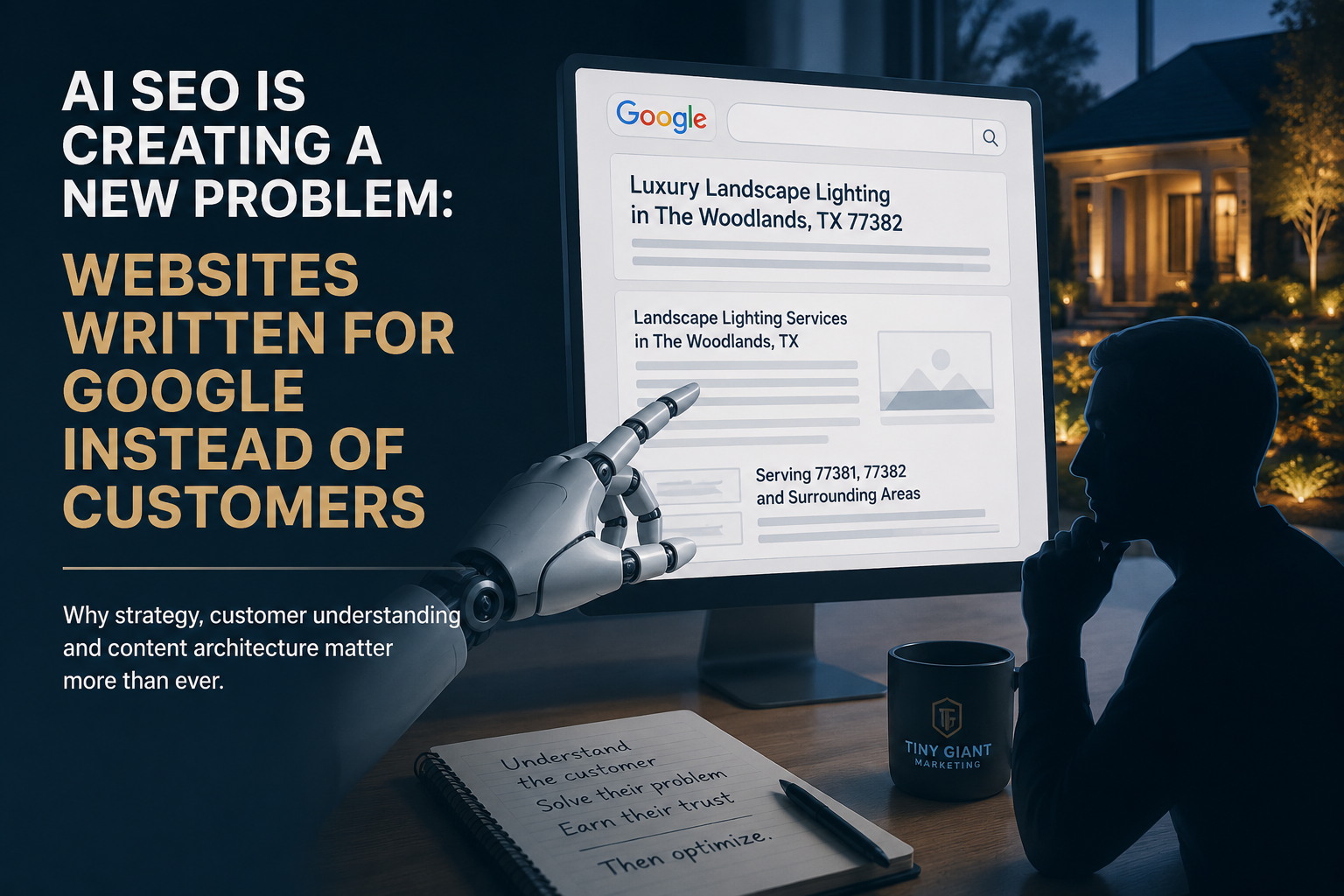
In our previous article about AI SEO and websites being written for Google instead of customers, we made an important distinction:
Keyword research tells us how someone searched. Customer research helps us understand why they searched.
That idea deserves a deeper look because it affects far more than keyword selection.
Traditional keyword research can tell us which phrases people use, how frequently those searches occur, how competitive they may be and which related topics customers are researching. Combined with search-intent analysis, that gives us a much better understanding of the search environment and where opportunities may exist.
But marketing requires another layer because behind every meaningful search is a person trying to accomplish something. Sometimes they're solving an immediate problem. Sometimes they're researching an unfamiliar purchase. Sometimes they're comparing alternatives. And sometimes they're simply trying to avoid making an expensive mistake.
Understanding that context changes how we communicate.
Instead of merely asking which keyword should appear on the page, we begin considering what prompted the search in the first place, what outcome the customer wants, which concerns could slow the decision, what they already understand and what information would help them feel confident taking the next step.
That's where SEO content begins becoming marketing rather than simply SEO copy.
Search Intent Isn't the Same as Purchase Motivation
SEO professionals frequently talk about search intent, and it's an important part of an effective SEO content strategy. A search may generally be informational, navigational, commercial or transactional, and understanding those differences helps determine what type of content should appear for a particular query.
Someone searching "how much does a custom pool cost?" is probably gathering information. Someone searching "custom pool builders near me" appears to have stronger commercial intent. A person searching for a particular pool company's name may already be evaluating that business.
But search intent only gets us so far because it describes the likely purpose of the search. It doesn't necessarily tell us what will ultimately influence the buying decision.
Imagine two homeowners searching "outdoor kitchen contractor Houston." Both have strong commercial intent and both appear to want essentially the same service.
One homeowner may be primarily concerned with design. They entertain frequently and want an outdoor kitchen that looks as though it was designed as part of the home rather than something added years later. They may be thinking about how the kitchen connects visually with the patio, pool and landscaping.
The other homeowner may care far more about durability. Perhaps they've seen outdoor cabinets rust, countertops crack or inexpensive materials deteriorate in Houston's heat and humidity. Their biggest question isn't necessarily who can build an outdoor kitchen; it's who understands how to build one that will still look good years from now.
The keyword is the same and the search intent is essentially the same, but the information each customer needs before making a decision is different.
If the website does little more than repeatedly advertise "professional outdoor kitchen installation in Houston," it may align beautifully with the target keyword while failing to speak meaningfully to either customer.
Ranking for the right search gets the business into the conversation. Understanding purchase motivation helps the business continue that conversation once the customer arrives.
This distinction is also important when looking at engagement and conversion performance. We shouldn't reduce Google's ranking systems to a simple formula where lower engagement automatically means lower rankings. Google uses many systems and signals to determine which pages are relevant and helpful. From a marketing perspective, however, if a page is attracting organic traffic and those visitors consistently fail to engage, inquire or convert, that should tell us something. The search strategy may be generating visibility without adequately satisfying the customer who arrives.
That is a marketing problem worth investigating regardless of what a single SEO metric says.
What Customer Vernacular Actually Tells Us
This is where customer vernacular becomes much more interesting than simply identifying alternate words for a keyword. We previously explored this subject in why vernacular matters in a customer persona strategy, where we described customer vernacular as the real-world language people use when talking about their needs, frustrations, goals and buying decisions. That includes the words customers use in searches, but it also includes the language they use during phone calls, consultations, reviews, emails, estimates and conversations with salespeople.
The important part is that vernacular can tell us more than what someone wants. It can reveal how the customer is thinking about what they want.
Consider a homeowner interested in adding shade to a backyard. An industry professional might describe the available solutions as a pergola, veranda, patio cover or attached roof structure. Those terms are useful because they're accurate, and they help both customers and search engines understand the different services being offered.
The homeowner, however, may describe the exact same need very differently.
They may explain that they love their backyard but it's simply too hot to use during the summer. Another homeowner may be frustrated because every time it rains, everyone has to move inside. Someone else may be less concerned about weather protection and more concerned about appearance because they want the new patio area to look like it was always part of the home rather than something somebody added later.
Those aren't simply alternate ways of saying "patio cover."
They're telling us something about the customer.
The first person is focused on comfort and usability. The second is thinking about protection from the weather. The third is concerned about architecture, appearance and design integration.
The keyword identifies the service category.
The vernacular begins revealing the desired outcome.
That distinction matters because customers rarely purchase a service simply because they want the technical object being sold. They purchase what they believe that service will allow them to do, solve, improve, prevent or experience.
Vernacular Can Reveal More Than Vocabulary
When marketers talk about customer language, there can be a tendency to think of vernacular as a list of alternative words.
Customer says "shade structure." Company says "patio cover."
Customer says "sprinkler timer." Irrigation company says "smart irrigation controller."
Customer says "delivery and setup." Logistics company says "white-glove final mile delivery."
Those distinctions are useful, but customer vernacular can tell us considerably more than vocabulary.
How someone describes a problem can reveal their level of familiarity with the service. It can expose uncertainty. It can identify a previous bad experience. It can reveal the outcome that matters most or the risk they're trying to avoid.
Even the way a customer frames a question can provide valuable context.
Consider the difference between a homeowner asking, "What does a composite deck cost?" and someone asking, "How hot does composite decking get around a pool during a Houston summer?"
They're both potentially interested in composite decking, but those questions suggest very different levels of familiarity. The first customer may still be deciding whether composite is financially realistic. The second has probably progressed further and is now evaluating a specific tradeoff that could influence the final material choice.
The words are giving us clues about the conversation the customer is ready to have.
That's why customer vernacular shouldn't be treated as a collection of phrases we sprinkle into website content to make it sound more natural. It helps us understand what customers know, what they don't know, what they're becoming concerned about and which information may logically need to come next.
Vernacular Can Reveal Where the Customer Is in the Decision
The same principle becomes especially useful when we consider the customer's stage in the buying process.
A homeowner who asks, "What's the difference between composite decking and pressure-treated wood?" is having a very different conversation from someone asking about a particular composite product line, heat retention, scratching or long-term color fading.
Both customers may ultimately purchase a deck, but one is still learning the category while the other is evaluating tradeoffs between specific solutions.
The same thing happens in our own industry.
One business owner may search "SEO company near me" because the website gets traffic but produces very few calls. That owner may believe the problem is SEO when the actual issue could involve messaging, the wrong traffic, weak conversion architecture or a combination of several things.
Another business owner can type exactly the same search because their previous SEO company sends monthly reports full of rankings and graphs, but they still don't understand what the agency is actually doing or whether any of it has produced meaningful business growth. Their search for an SEO company may really be a search for transparency, accountability and a clearer connection between marketing activity and revenue.
Same keyword.
Same apparent search intent.
Very different reason for beginning the search.
This is why the phrase someone types into Google is valuable, but incomplete. The search phrase identifies the door the customer walked through. Their vernacular and motivations help us understand why they walked through it.
The Best Website Content Creates Recognition
Think about what happens when you're researching something you don't know much about.
You visit several websites and quickly notice that most say essentially the same thing. One promises quality. Another talks about years of experience. Another claims exceptional customer service. Everyone is an industry leader, everyone provides customized solutions, and everyone would like you to contact them today.
Then you reach a website that addresses something you've actually been wondering about.
Perhaps you're considering improving your backyard and the company explains that homeowners often aren't sure whether a pergola or covered patio makes more sense. Instead of immediately promoting one service, the content explains that the answer depends on how much shade and weather protection you want, how the space will be used and how closely you want the new structure to integrate with the home.
Suddenly, the company feels different.
Not because it used a clever slogan or repeated the keyword more often. The difference is that the content recognized the decision you were already trying to make.
That moment of recognition is extremely valuable in conversion-focused website content because it demonstrates understanding before the customer ever speaks with the company.
A visitor doesn't consciously think, "This business has successfully incorporated my vernacular into its website strategy." They simply begin feeling that the company understands what they're trying to accomplish.
That's the goal.
Customer Language Isn't the Same as Industry Language
There's another layer to vernacular that becomes particularly important when businesses create their own website content.
Companies naturally develop an internal language because they work in the same industry every day. A contractor may talk about hardscapes, structural tie-ins, drainage mitigation, composite materials or load requirements. A technology company may discuss integrations, APIs and implementation environments. A logistics company may use terms such as final mile, reverse logistics, white-glove delivery and warehousing.
Those terms may be completely accurate.
The customer simply may not use them yet.
A homeowner is more likely to begin a conversation by saying, "Water keeps collecting next to the patio," than by asking for drainage mitigation. Someone considering new windows may say, "This room is always hot," before they ever begin talking about solar heat gain or glazing.
That doesn't mean professional terminology should disappear from website content. Expertise matters, and part of a company's job is helping customers better understand the problem and the available solutions.
The better approach is to bridge the languages.
Strategic website content can begin by recognizing the problem in the customer's language, explain what's causing it, introduce the professional terminology when that terminology becomes useful, and then provide a clearer path toward a solution.
Now the website isn't simply echoing what the visitor already knows. It's helping the visitor become a more informed customer.
That's an important difference.
Sometimes the Customer Uses the “Wrong” Word — and That's Valuable Information
There's an interesting situation that occurs in almost every industry: customers frequently use terminology that isn't technically correct.
From the company's perspective, the instinct may be to immediately correct them.
From a marketing perspective, we should first pay attention.
If homeowners repeatedly call a certain patio structure a pergola even when a contractor would technically classify it differently, that tells us something about how customers search and understand the category.
If a customer calls every type of automated window covering a motorized blind, even when the product is technically a shade, that language may still be important because it represents how the customer begins the search.
This doesn't mean a business should intentionally use incorrect terminology throughout its website. It means the content may need to acknowledge both languages.
A page can meet the customer where they are, explain the distinction and then move them toward the correct terminology.
That creates a useful bridge between SEO keywords, customer vernacular and professional expertise.
It also creates an opportunity to rank for the phrases customers actually use without forcing the business to abandon accurate language.
Long-Tail Keywords Often Bring Us Closer to Customer Language
This relationship between customer vernacular and SEO becomes particularly interesting when we look at long-tail keywords.
Broad keywords such as "pool builder," "plumber," "SEO company" or "outdoor kitchen contractor" are useful because they identify categories of demand. But longer, more specific searches often reveal more about what the customer is actually trying to accomplish.
Compare "pool builder" with "how long does it take to build a custom pool in Houston?"
Compare "patio cover contractor" with "should I build a pergola or covered patio for more shade?"
Or compare "water heater replacement" with "should I repair or replace a 12-year-old water heater?"
The longer searches contain more context. They often reveal the customer's concern, familiarity with the subject, stage of consideration or the specific decision they're trying to make.
That's why long-tail keyword research can be valuable for far more than discovering lower-volume SEO opportunities. Those searches can provide clues about customer questions, objections, comparisons and desired outcomes.
They also become useful when thinking about AI search and zero-click search behavior. In how to win customers through zero-click search, we discussed how search is increasingly becoming an environment where people ask complete, conversational questions and expect useful answers without necessarily following the traditional keyword-to-click path.
That makes understanding the question behind the search even more important.
There is one important caution, however. Discovering a useful long-tail keyword doesn't mean we should repeat that exact phrase throughout the page. Doing that simply brings us back to creating content around what we think the algorithm wants.
A better SEO content strategy identifies the underlying question and provides a thorough, natural answer.
The keyword gives us a clue about the conversation.
The customer tells us what the conversation needs to accomplish.
Customer Vernacular Can Help Us Find Content We Didn't Know We Needed
There is another SEO opportunity here that businesses can easily miss.
Keyword research often begins with known services. A company sells outdoor kitchens, so we research outdoor-kitchen keywords. A plumber provides water-heater repair, so we research water-heater terms. An agency provides SEO, so we research SEO-related searches.
Customer language can uncover subjects that don't fit neatly into the service list.
A customer may repeatedly ask whether a particular project requires permits. Another may want to know how much disruption to expect. Someone may ask how two services compare, whether an existing structure can be reused, which option requires less maintenance, or why one solution costs considerably more than another.
Those questions can become valuable content opportunities because they're connected to real customer decisions.
Some may belong on service pages. Others may justify a blog article, FAQ, comparison page or supporting resource.
This is where customer research, long-tail keyword research and website content strategy begin supporting one another.
Instead of starting with, "We need another blog this month, what should we write about?" the company can begin with the questions customers are already asking.
That's a considerably stronger source of content ideas.
AI Makes Customer Vernacular More Important, Not Less
AI is remarkably good at generating information around a topic.
Ask it to write about "outdoor kitchens Houston," and within seconds it can produce content about grills, refrigerators, countertops, cabinets, entertaining, weather resistance, design and installation.
Much of that information may be accurate and useful. But unless AI has meaningful context about the business and its customers, it doesn't know which parts deserve the most attention.
It doesn't automatically know that prospects repeatedly ask whether an outdoor kitchen can be added to an existing patio. It doesn't know that homeowners are concerned about smoke collecting underneath a patio cover. It doesn't know that customers frequently regret choosing inexpensive outdoor cabinets that weren't designed for long-term exposure to Houston weather.
Nor does it automatically know how those customers describe those concerns.
That knowledge is often already embedded inside the organization through owner-client conversations, sales inquiries, project estimates, emails, reviews and years of explaining the same issues to customers.
The challenge isn't necessarily creating more information.
It's recognizing which information has strategic marketing value.
AI Can Sound Knowledgeable Without Knowing Your Customer
This is one of the most important things businesses need to understand about AI-generated content: AI is very good at sounding knowledgeable.
Give it a service, keyword and location, and it can usually produce a polished page that looks as though it belongs on a professional website. The grammar may be excellent. The headings may be logical. The target keyword may appear in all the expected places. The page may even answer several common questions.
But technically polished content can still be strategically generic.
That's because knowing a great deal about a type of customer isn't the same thing as understanding your customers.
A general AI model may know the common concerns people have when hiring a pool builder. It doesn't automatically know which concerns your customers raise most frequently, which misconceptions your team repeatedly corrects, why customers choose your company instead of a competitor, or which explanation consistently changes the direction of a sales conversation.
Without that context, AI fills the gaps using generalized information.
If every pool builder, remodeling contractor, plumber, attorney and logistics company gives AI essentially the same prompt, we shouldn't be surprised when the resulting websites begin sounding similar.
The words may change.
The underlying marketing doesn't.
This is one of the central problems we explored in AI SEO Is Creating a New Problem: Websites Written for Google Instead of Customers. AI isn't inherently the problem. The problem begins when AI is expected to create the marketing before it has been given enough meaningful customer and business context.
Your Best Marketing Information May Already Exist Inside Your Business
Businesses sometimes assume customer research requires discovering information they don't already have.
Often, the first opportunity is simply recognizing the value of information they've been hearing for years.
Every sales conversation contains clues. Questions customers ask before requesting an estimate can tell us where uncertainty exists. Questions that appear immediately after an estimate may reveal what is preventing the decision. Repeated objections can identify concerns the website isn't addressing early enough, while reviews can reveal which parts of the experience mattered enough for customers to mention after the purchase.
Even misunderstandings are useful.
If customers repeatedly confuse two services, that's information. If prospects consistently underestimate part of a project, that's information. If people keep using terminology that differs from the language used inside the industry, that's information too.
Over time, those patterns can influence website content strategy, SEO content, landing pages, FAQs, calls-to-action and even how services are explained during the sales process.
The objective isn't to copy every customer quote onto a website or create a page for every question anyone has ever asked.
It's to understand what those conversations collectively tell us about how customers think and make decisions.
Customer Understanding Changes More Than the Copy
One reason customer persona strategy matters so much is that understanding the customer doesn't just change the words on the page.
Deep customer insight can fundamentally change the content hierarchy and structure of the website.
Consider homeowners planning a major renovation who consistently express concerns about contractor communication and project timelines because they or someone they know had a terrible previous experience.
If those concerns heavily influence the hiring decision, communication and project expectations probably shouldn't be buried in an FAQ near the bottom of the website.
They may need to appear much earlier in the conversation.
Likewise, if buyers routinely struggle to understand the difference between two services, the website may need a comparison before presenting a lengthy company history. If qualified prospects hesitate to make contact because they have no idea what a service realistically costs, transparent pricing guidance may have considerably more marketing value than another generic paragraph about years of experience.
This is why audience insights, customer vernacular and content architecture are so tightly connected.
A page must do more than contain every fact a company wants to communicate. It needs to organize that information in a sequence that helps someone evaluate the decision.
Effective salespeople do this naturally. They listen, identify the source of uncertainty, explain what matters and guide the conversation forward.
A well-designed website should function in much the same way.
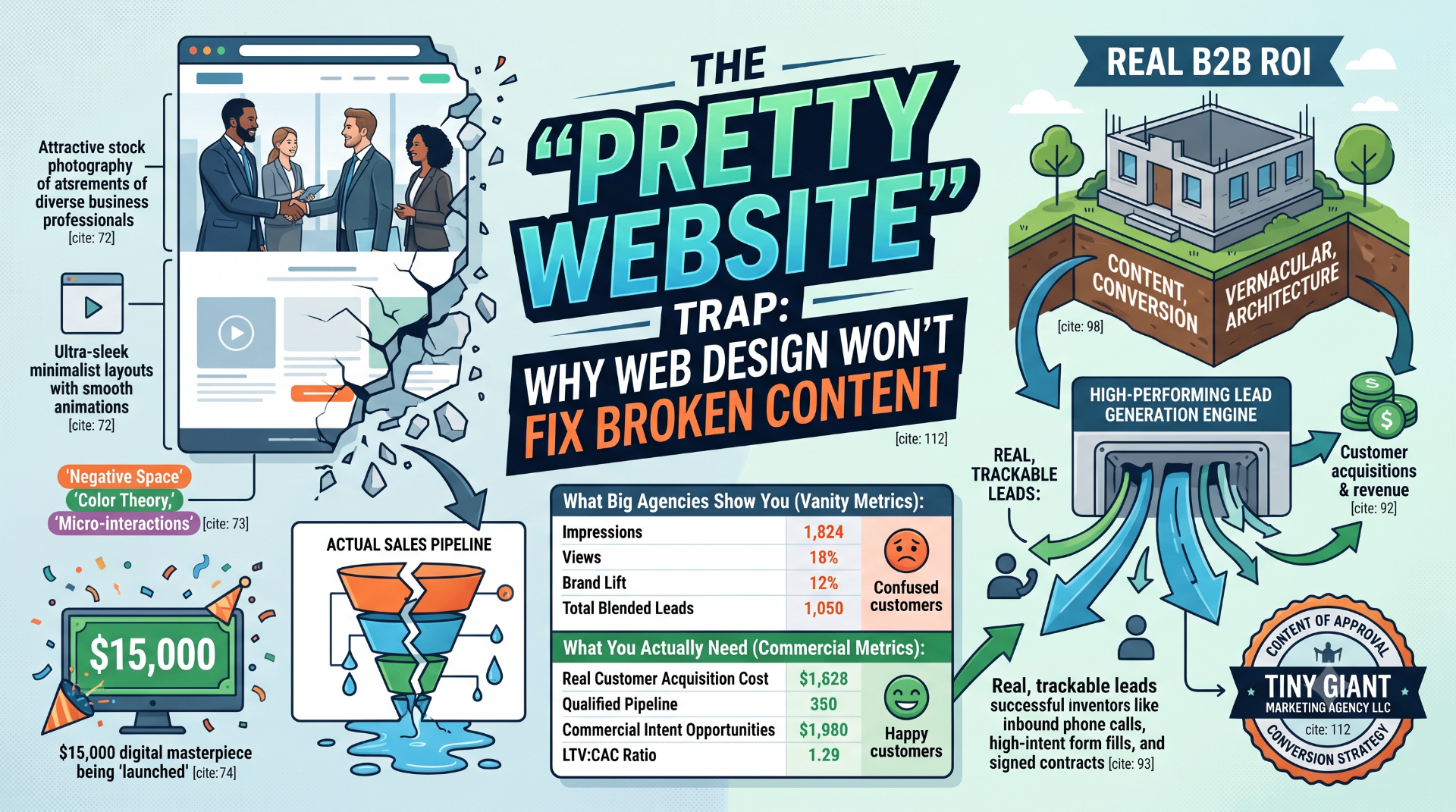
This is also why, as we discussed in beautiful website design can't fix broken content, website design shouldn't be expected to rescue weak messaging. A beautiful page can't compensate for a conversation that doesn't understand the person reading it.
The Problem With Starting With “What Do We Want to Rank For?”
"What do we want to rank for?" is a legitimate SEO question.
It just shouldn't be the only question driving the content strategy.
When the entire process begins with rankings, it's easy to create pages centered on what the business wants Google to see rather than what the customer needs to understand.
A stronger SEO content strategy combines search demand with customer context.
We still want to know which keywords matter. We still want to understand search volume, search intent, competition, related searches and long-tail opportunities.
But we also want to understand who we're trying to attract, what that customer is trying to accomplish, what concerns influence the decision, how familiar they are with the service, what terminology they understand and which information gives them enough confidence to take the next step.
Now keyword research becomes much more useful because it has context.
Instead of developing content around a phrase and then trying to make that phrase persuasive, we're developing content for the person who happens to use that phrase while searching.
That's a very different approach to SEO.
Google Is Trying to Understand Meaning, Too
There's another reason natural customer language and useful content matter.
Google has become increasingly sophisticated at understanding meaning, concepts, relationships and context rather than relying solely on exact keyword matches. That doesn't eliminate keyword research or traditional on-page SEO. It changes the way we should use them.
We don't need to force an exact-match phrase into a sentence where it doesn't naturally belong simply to reassure ourselves that Google knows what the page is about.
As we discussed in our AI SEO article, awkward location stuffing, repetitive exact-match phrases and creating content around every conceivable search variation can make a website increasingly unnatural for the very people we're trying to attract.
The better objective is to clearly establish the page's subject, service and geographic relevance and then provide genuinely useful information surrounding that topic.
That gives us room to write naturally.
And natural writing gives us room to speak in language customers understand.
Google's own Search guidance encourages website owners to create helpful, reliable, people-first content and specifically notes the importance of using words people themselves would use when looking for the content. That is not an argument against SEO. It's an argument for applying SEO to genuinely useful content rather than allowing optimization to become the reason the content exists.
SEO and customer-focused content shouldn't be opposing strategies.
Done correctly, each makes the other stronger.
The Customer Should Become Part of the AI Context Before the Keyword Does
This may be one of the most important changes businesses need to make when using AI for marketing.
Many AI content requests begin with the subject.
"Write an SEO page about..."
Then come the target keyword, location, desired word count and perhaps a list of services or headings.
At that point, AI is expected to create the marketing.
The sequence is backward.
Before AI can help create meaningful, conversion-focused content, it needs context about the customer and the business. It needs to understand who the content is for, what that customer is trying to accomplish, what concerns influence the decision, what terminology they use and understand, what the company actually provides, what claims can legitimately be made and what information may help the visitor move forward.
Only after that foundation exists should strategic SEO requirements, primary keywords, secondary keywords and long-tail keywords begin shaping the content.
We don't want AI independently deciding what matters to the customer because it doesn't have a reliable way to know what matters specifically to your customers.
We want AI working from customer knowledge that has already been established.
That's the difference between asking AI to produce content around a service and using AI within a larger website content strategy.
People-First Content Doesn't Mean SEO-Last Content
There's an important distinction here because "write for the customer" can easily be misunderstood as "forget about SEO."
That's not what we're suggesting.
A beautifully written page nobody can find isn't particularly useful to the business. Neither is a perfectly optimized page that attracts visitors and gives them no reason to contact the company.
We need both.
SEO helps us understand search demand and connect the website with relevant searches. Customer research helps us understand what that traffic needs once it arrives. Customer vernacular helps the content feel familiar and understandable. Content architecture organizes the information around the decision. Conversion optimization helps move qualified visitors toward an appropriate next step. Analytics tells us whether the strategy is actually producing business results.
AI can accelerate almost every part of that process.
What it shouldn't do is replace the strategic thinking connecting those pieces.
When everything works together, good SEO content begins to feel less like "SEO copy" and more like a useful conversation with a knowledgeable person who understands why the customer is there.
That's a considerably higher standard than simply checking off a list of target keywords.
Search Traffic Is Still Made of People
Marketing dashboards turn human behavior into numbers. We look at organic sessions, search impressions, clicks, engagement rates, conversions and dozens of other measurements because good marketing should be measurable.
But an organic session isn't really a session.
It's a person.
That person arrived with an expectation. They may be trying to solve a problem, compare two expensive options, understand something unfamiliar or decide which company they trust enough to call.
When we focus exclusively on optimizing the metrics, it's easy to lose sight of the individual represented by them.
That brings us back to one of the principles behind our previous discussion about AI SEO:
The purpose of SEO is to help search engines connect the right customer with a website that customer will love.
Keywords help make that connection possible, but keywords aren't a substitute for understanding the customer.
Understanding the person behind the search is what allows search visibility to become relevance, relevance to build trust and trust to eventually become meaningful action.
The Competitive Advantage Isn't More Content. It's Better Understanding.
AI has dramatically reduced the time and cost required to produce content, and that's not going away. Businesses will create more service pages, location pages, blogs, FAQs and marketing materials than ever before.
As the amount of AI-generated content grows, simply publishing more words becomes less meaningful as a competitive advantage.
Understanding customers becomes more valuable.
Not just understanding what they type into Google, but recognizing how they describe the problem, what they're trying to accomplish, which risks they're trying to avoid, what terminology they understand, what remains unclear and what ultimately gives them enough confidence to choose one business over another.
That is why customer vernacular matters even more in the age of AI.
A keyword can tell AI what subject to write about.
A long-tail keyword can provide more context about the question.
SEO data can show us where search demand exists.
But none of them, by themselves, tell AI what matters most to your customer.
That understanding has to come first.
Give AI only a keyword and it can create content. Give AI genuine customer understanding, a clear business strategy and the appropriate SEO context, and it can help create something considerably more valuable:
Marketing that gets found because it understands search — and works because it understands the customer.
Your Customers Are Already Telling You What Matters.
The challenge is turning those customer insights into SEO, website content and marketing that gets found and converts. Tiny Giant Marketing Agency combines customer understanding, SEO strategy, content architecture, analytics and AI to build marketing around the people businesses actually want to reach.