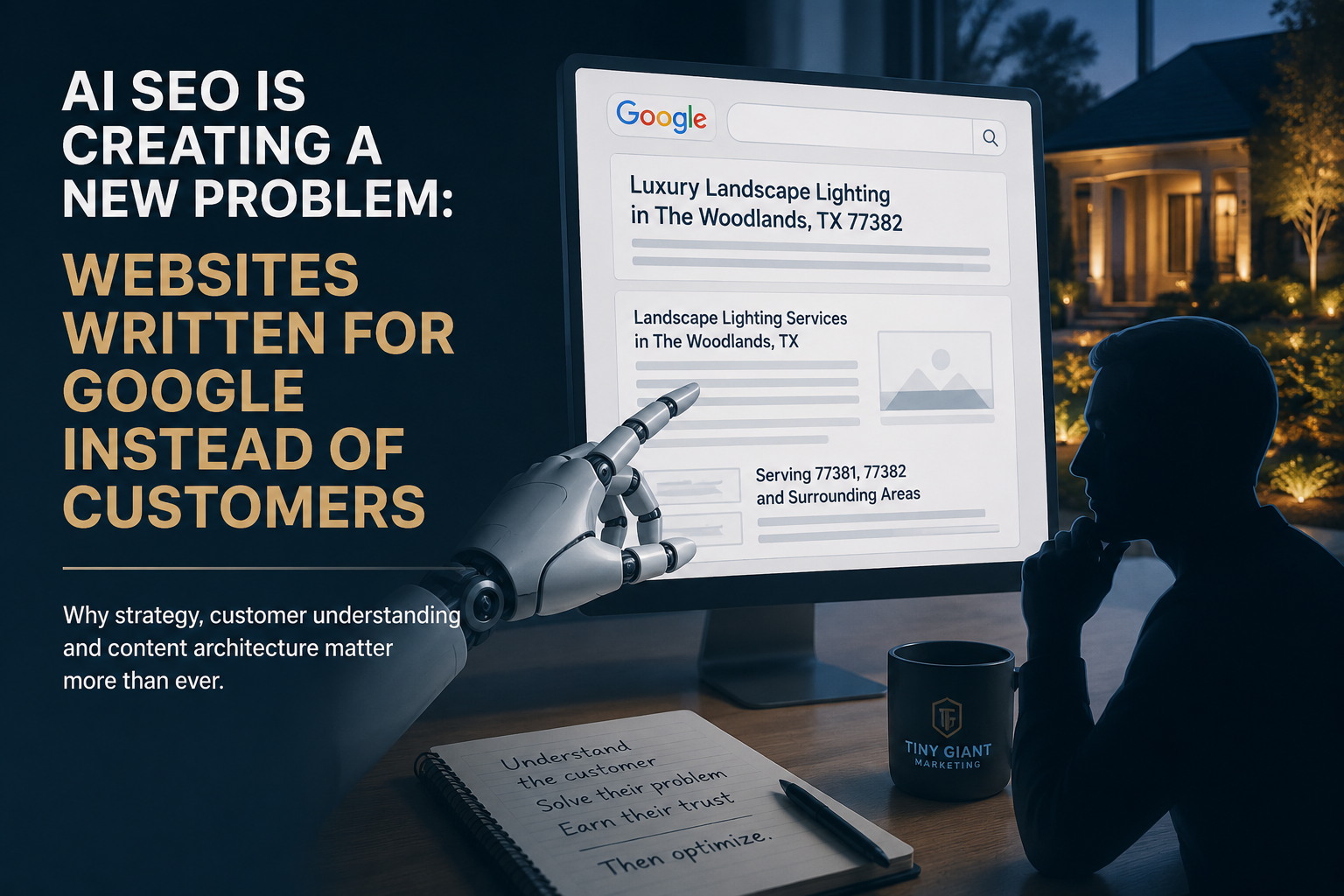
AI has made it easier than ever to optimize a website for search engines. That should be a good thing.
Businesses can research keywords faster, analyze competitors, develop content ideas, improve existing pages, identify customer questions and create new content in a fraction of the time it once required.
But we're beginning to see an unintended consequence. AI can help a business achieve short-term search visibility while simultaneously creating a worse website for the humans who actually arrive there.
The problem isn't AI. The problem is what businesses are asking AI to optimize for. When the instructions are primarily about rankings, keywords, locations, word counts and search engines, AI can produce exactly what was requested: a website that appears highly optimized for SEO. Unfortunately, the customer may have been completely forgotten in the process.
And that's a problem because we believe the purpose of SEO is to help search engines connect the right customer with a website that customer will love. Getting found is only the beginning.
AI Has Made It Easier to Create Bad SEO at Scale
Keyword stuffing isn't new. Years ago it was painfully obvious: "Looking for a Houston plumber? Our Houston plumbing company provides Houston plumbing services to Houston homeowners looking for an experienced Houston plumber." Nobody would mistake that for natural writing.
Search engines became better at identifying these tactics, marketers adapted and blatant keyword stuffing became less common. Then AI arrived.
Today, businesses can create hundreds of pages containing keywords, service variations, cities, neighborhoods, ZIP codes, FAQs and related search phrases almost instantly. The writing is grammatically better and the keyword stuffing is more sophisticated, but the underlying problem can be exactly the same.
You start seeing website headings such as:
- "Christmas Light Installation in The Woodlands, TX 77382"
- "Luxury Landscape Lighting in Spring, TX 77386"
- "High-end residences throughout 77381 and 77382."
There is nothing inherently wrong with identifying where your company provides services. Geographic relevance is an important part of local SEO. The question is whether that information is being communicated naturally because it helps the customer, or whether it exists primarily because someone believes Google needs to see the location repeatedly.
There's a simple test we like to use: would you actually say it to a customer? Imagine answering the phone and saying, "Thank you for calling. We provide luxury landscape lighting for high-end residences throughout 77381 and 77382." Nobody talks that way.
When website copy begins sounding unlike the way knowledgeable people actually communicate with customers, that's usually a clue that something has gone wrong. The content isn't really being written for the customer anymore. It's being written for the search engine.
The Irony of Using AI to Write for Google's AI
Businesses are increasingly using artificial intelligence to create content intended to influence Google's increasingly sophisticated artificial intelligence.
Google has spent decades developing systems capable of understanding language, context, relationships, geography and search intent. Yet businesses are still approaching SEO as though Google needs a city name, ZIP code or exact-match keyword repeated throughout a page to understand what the page is about.
This isn't simply our interpretation of good SEO. Google Search Central recommends creating "helpful, reliable, people-first content," and says its automated ranking systems are designed to prioritize information created to benefit people rather than content created to manipulate search rankings. Google even provides warning signs for "search engine-first content," including content created primarily to attract search visits and the extensive use of automation to produce content.
Google makes another distinction that's particularly important: SEO itself isn't the problem. In Google's words, SEO can be helpful when it is applied to people-first content rather than search-engine-first content.
Its newer guidance for generative AI search goes even further, advising website owners to focus on what users want rather than creating separate content for every possible search variation. In other words, Google doesn't need us to write awkwardly for Google.
That doesn't mean businesses shouldn't optimize their websites. Keywords, page titles, headings, internal links, geographic relevance and technical SEO still matter. But those elements should help Google understand genuinely useful content. They shouldn't become the reason the content exists in the first place.
AI Isn't the Problem
AI-generated content isn't automatically bad content. We use AI ourselves. It can be an incredibly powerful marketing tool for customer and competitor research, keyword analysis, content organization, topic development, editing, identifying gaps, analyzing customer questions, developing content architecture and accelerating the writing process.
Google isn't categorically opposed to AI-generated content either. Its guidance focuses much more heavily on the purpose and quality of the content than the tool used to create it.
The problem begins when AI is given SEO instructions without enough customer context. Tell AI to "write a 1,500-word SEO page targeting luxury landscape lighting in The Woodlands, Texas, including ZIP codes 77381, 77382 and 77383," and it will. It may even produce a technically impressive page.
But AI doesn't inherently know the customer behind that search. It doesn't know whether the homeowner is primarily concerned about security, architecture, curb appeal or entertaining outdoors. It doesn't know whether they're worried about light spilling into a neighbor's yard, damage to landscaping during installation, fixture quality, ongoing maintenance or simply cost.
More importantly, AI doesn't know which of those concerns matter most to your customers, the questions your sales team hears every week, or what finally gives a homeowner enough confidence to move forward. Unless we provide that context, AI has to fill in the blanks with the same general information available to everyone else.
Your Customer Doesn't Care About Your Keywords
Customers don't visit websites to admire SEO. They visit because they need something. Consider a homeowner who searches for "landscape lighting company near me." That's the keyword, but it isn't necessarily the customer's real question.
The person behind that search may be wondering how to make the house look better at night without making it look overdone. They may want someone to design the lighting rather than simply install fixtures. They probably want some idea of what professional landscape lighting costs and what happens when something eventually needs service.
There's another important distinction: keywords and customer vernacular aren't necessarily the same thing. A keyword tells us what someone typed into Google. Customer vernacular tells us how that person actually talks about the problem, what they call it, what they're concerned about and how they describe the outcome they want.
Keyword research tells us how someone searched. Customer research helps us understand why they searched. Understanding both is what allows us to create content that can rank and convert.
That's why we don't begin website content with a keyword list. We begin by understanding the customer — their motivations, questions, concerns, objections and the language they actually use. SEO then helps us connect those needs to how people search. AI comes later, as a tool for executing the strategy rather than inventing it.
Ranking Is Not the End Goal
Rankings matter. We wouldn't invest in SEO if they didn't. But ranking is not where the customer journey ends. It's where the opportunity begins.
Rankings, impressions, clicks and organic traffic help us understand whether a website is becoming more visible. But none of those metrics necessarily means the business acquired another customer.
When someone chooses your result and arrives on your website, the search engine has done its job. The website now has to do something considerably more difficult: convince that visitor they've found the right company. SEO gets the right person through the door. The website experience determines whether they decide to stay.
The SEO Technically Worked. The Marketing Didn't.
Imagine a business publishes several heavily optimized pages. Google indexes them, impressions increase, rankings move upward and organic traffic climbs. On the surface, everything looks encouraging.
But we also need to know what those visitors did after they arrived. Did phone calls increase? Did more people request quotes? Were the new leads qualified? Did the additional traffic create additional revenue?
Suppose a website previously received 1,000 visitors per month and generated 50 leads — a 5% conversion rate. After publishing a large amount of AI-optimized content, traffic grows to 1,500 visitors per month but the site still generates only 50 leads. Traffic increased by 50%, which looks terrific on an SEO report. But the percentage of visitors becoming leads fell from 5% to roughly 3.3%.
If you're the business owner, which number matters more? The SEO technically worked. The marketing didn't.
What Bounce Rate and Engagement Can Actually Tell Us
If someone visits a page and leaves quickly, we shouldn't automatically conclude that Google will penalize the website. SEO isn't that simple, and Google doesn't tell us to treat bounce rate as a direct ranking factor. But that doesn't make the behavior irrelevant.
If a page is attracting significantly more search traffic while producing weak engagement and fewer conversions per visitor, the business should pay attention. Perhaps the search intent is wrong. Maybe the page technically answers the query but doesn't give the visitor a compelling reason to continue. The content may feel generic, or the call-to-action may appear before enough trust has been established.
Those are marketing questions, and analytics helps us ask them.
There Are Two Ways to Measure SEO Success
The first is search performance: rankings, impressions, clicks, indexed pages and organic traffic. Those metrics tell us whether search engines are finding the content and whether the website is gaining visibility.
The second is business performance: engagement, qualified leads, phone calls, form submissions, conversion rates, acquisition costs, sales and revenue.
The mistake is assuming that success in search performance automatically produces success in business performance. It doesn't. A business can dramatically increase organic traffic while attracting the wrong audience, rank a page that doesn't answer the visitor's actual questions, or dominate a search phrase that produces very little profitable business.
Good SEO should improve search performance in service of business performance. Otherwise, we're optimizing metrics rather than marketing.
Website Structure Matters as Much as the Words
Another problem we're seeing with AI-generated content isn't poor writing. Often, it's poor structure. AI may successfully generate every topic it was asked to include, but nobody determined how those topics should be organized around the customer's decision-making process before the writing began.
That's why we believe content architecture should come before content generation. A good service page should feel more like a conversation with a knowledgeable salesperson than an expensive brochure.
When someone first arrives, the page should quickly confirm that they're in the right place. From there, the content should demonstrate an understanding of what they're trying to accomplish and the concerns preventing them from moving forward. Only then does it make sense to explain the service, the company's approach and the reasons the customer should trust the business.
As the visitor moves through the page, uncertainty should decrease and the next step should become increasingly obvious. Compare that with simply asking AI to "write 2,000 words about pool construction in The Woodlands, Texas." Both approaches produce a lot of content. Only one deliberately builds a customer journey.
Your Website Should Start With the Customer, Not the Company
Businesses naturally want to talk about their experience, products, process, equipment, awards, company history and mission. All of those things can matter, particularly when they provide evidence that the business can deliver what it promises.
But customers don't typically arrive at a website wanting to learn about a company. They arrive trying to make a decision, solve a problem or accomplish something. That's where the conversation should begin.
Instead of saying, "Here's everything we want you to know about us," the website should say, "We understand why you're here. Here's what you need to know." That's customer-first content.
Google Doesn't Need You to Repeat Yourself
If you're a pool builder serving The Woodlands, there is no need to insert "Pool Builder The Woodlands TX" into every other heading or repeatedly remind readers which ZIP codes are in the service area. Establish geographic relevance naturally and then focus on being useful.
Explain what customers should consider when planning a pool, the options available, realistic expectations, common mistakes, your process, costs where appropriate, typical timelines, examples of completed work and the questions homeowners regularly ask. That information helps someone evaluate whether your company is the right choice — and it gives search engines substantially more meaningful context than repeating the same geographic phrase.
AI Should Accelerate Strategy — Not Replace It
The biggest mistake businesses can make with AI isn't using it to create content. It's asking AI to create the marketing strategy before the strategy exists.
Before we ask AI to write a service page, we need to give it a factual and strategic foundation that defines the customer, their motivations, the problem being solved, the evidence supporting the business and the intended customer journey. If we give AI nothing but keywords, it will write around keywords.
The Future of SEO May Actually Be More Human, Not Less
Generic content is becoming incredibly inexpensive to produce. Anyone can ask AI to generate a 2,000-word service page or dozens of location pages using essentially the same template. When everybody can create commodity content, simply having more content is no longer a significant competitive advantage.
That puts greater value on something AI can't manufacture on its own: genuine knowledge of the business and its customers. The experience gained from completing hundreds of projects matters. The questions customers repeatedly ask matter. Your perspective on the tradeoffs between different solutions matters.
Anyone can generate 2,000 words now. The competitive advantage is knowing which 2,000 words actually matter to your customer.
Optimize for the Person Behind the Search
SEO still matters. We believe strongly in it. Keywords matter, technical optimization matters, search intent matters, and content structure, internal linking, geographic relevance and authority all matter. But none of those things should exist independently of marketing strategy, customer experience, analytics and conversion rate optimization.
We shouldn't build websites for algorithms. We shouldn't stuff pages with every city and ZIP code we want to rank for. We should build websites that answer customers' questions, understand their problems, reduce uncertainty, establish trust and give people a compelling reason to take the next step.
Google gets the visitor to the website. Then the marketing has to work. Ranking is not the end goal of SEO — ranking earns your business the opportunity to be considered. What happens after the click determines whether your SEO becomes traffic or business.
Need help building your strategy?
Talk to our team about a marketing plan that fits your goals.