Imagine you're considering a major backyard renovation. You've been thinking about adding a covered patio, perhaps an outdoor kitchen, or even a swimming pool. You have a general idea of what you'd like to accomplish, but you're not sure which contractor would be the right choice.
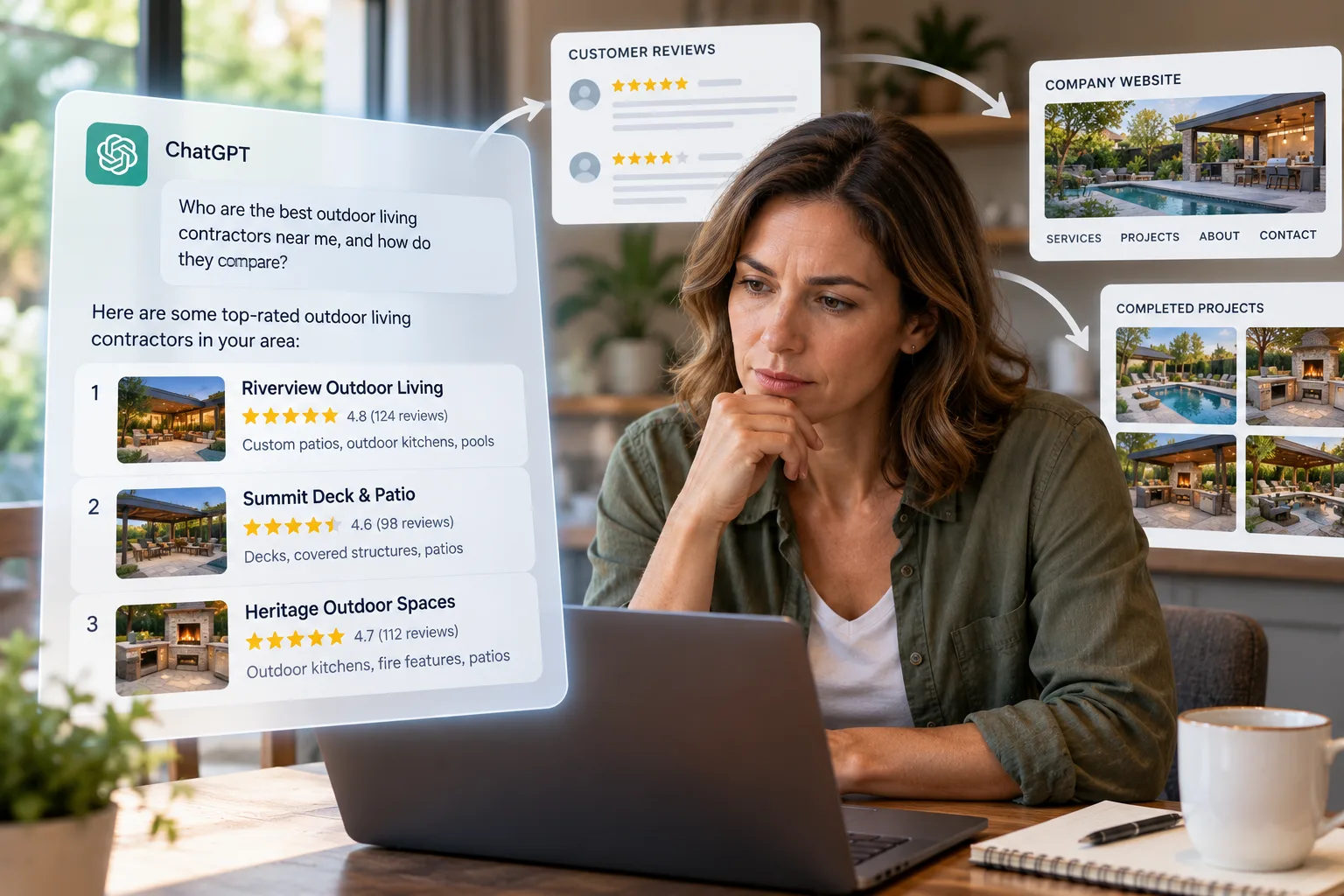
Not long ago, you might have started by asking neighbors for recommendations or searching Google for contractors in your area. Today, you might begin by asking an AI assistant, "Who are the best outdoor living contractors near me, and how do they compare?"
Within seconds, you receive a list of businesses, descriptions of their services, and perhaps summaries of customer reviews. Some recommendations may even include explanations of what makes one contractor different from another.
That's certainly useful information. You've gone from not knowing where to begin to having several companies worth considering. But does that mean you're ready to hire one of them?
If you're about to invest $75,000 in your backyard, probably not.
You may still want to visit their websites, look at photos of completed projects, read reviews from actual customers, understand their construction process, and decide whether you're comfortable trusting one of these businesses with a significant investment in your home.
And that's where the conversation about artificial intelligence and marketing becomes much more interesting.
AI may help customers discover and compare businesses, but a recommendation doesn't eliminate the need for customers to establish trust.
As businesses grow increasingly concerned about whether AI recommends them, we should also consider what happens after a recommendation. Being discovered is important, and being considered is valuable, but neither necessarily means a customer has developed the confidence to choose you.
AI Is Changing How Customers Discover Businesses
Growing evidence shows that artificial intelligence is becoming part of how consumers research local businesses, and the numbers are worth examining.
In March 2026, BrightLocal published findings from its Local Consumer Review Survey, which included 1,002 U.S. adults. Of those respondents, 455 reported using AI tools for local business recommendations during the previous year.
The study found that 45% of respondents had used AI for local business recommendations, compared with just 6% in its 2025 survey. Of respondents who used AI for this purpose, 63% said they trusted its recommendations.
For business owners, those findings suggest that AI is becoming another way potential customers discover companies they may never have considered otherwise. But what makes the research particularly interesting isn't simply the growing adoption of AI. It's what customers reported doing after receiving those recommendations.
Among the AI users surveyed, 88% said they checked the legitimacy or source of reviews referenced by AI tools, while 97% reported sometimes comparing AI recommendations against reviews from real customers.
Think about what that suggests. Many of the same consumers who reported trusting AI recommendations also wanted to verify the information behind them.
Of course, these findings reflect what survey respondents reported about their behavior, rather than direct observation of every purchasing decision. Nevertheless, they raise an important distinction between trusting AI to help identify businesses and trusting a particular business enough to hire it.
A customer may be perfectly comfortable asking AI which contractors deserve consideration while still needing to investigate those contractors independently before deciding.
Why Do People Trust AI Recommendations?
Consider asking an AI assistant to compare several businesses. Instead of listening to a single company's sales pitch, the customer receives what appears to be an organized comparison assembled from multiple sources. The response may include qualifications, services, reviews, and explanations of why certain businesses are worth considering.
For someone unfamiliar with an industry, that can create an impression of objectivity. The customer may feel AI is helping them evaluate options rather than trying to sell them a particular service.
That perception matters because customers often approach promotional messages with some degree of skepticism. When a business describes itself as the best, most experienced, or most reliable provider, the customer recognizes that the company has a financial interest in being chosen. An AI recommendation may appear to come from a source without that same direct interest.
However, perceived neutrality and actual accuracy aren't the same. AI can summarize available information without independently establishing whether every claim is accurate, current, or relevant to the customer's particular circumstances. It may also omit details that would significantly influence a decision.
Research suggests that people's willingness to rely on AI depends partly on what they're asking it to do.
A 2025 meta-analysis published in Psychological Bulletin examined 163 studies involving more than 82,000 participants. The researchers found that preferences for AI versus human judgment varied according to factors such as AI's perceived capability and whether the decision required personalization.
This distinction is especially relevant when we're discussing services rather than standardized products. Someone might feel comfortable relying on AI to explain the differences between composite and natural wood decking, but choosing a contractor to build a deck involves additional considerations that product comparisons alone can't resolve.
The customer needs to decide whether the contractor understands the project, can deliver the expected results, and will act responsibly if something unexpected happens.
AI may help organize the information needed to make that judgment, but it doesn't remove the human considerations involved.
Trusting a Recommendation Isn't the Same as Trusting a Business
When someone recommends a business, we often evaluate two things at once: the credibility of the person or system making the recommendation and the credibility of the business being recommended.
Those judgments can overlap, but they're not identical.
Suppose a trusted neighbor recommends a contractor who recently completed a similar project. The recommendation may carry considerable weight because the homeowner knows the neighbor, understands something about their expectations, and can ask questions about the experience.
An AI recommendation operates differently. It may draw upon a broader collection of information, including business descriptions, published reviews, and other available sources. That breadth can help, especially when someone is unfamiliar with the businesses in an area.
But the customer may not know how the recommendation was assembled, which information was emphasized, or whether the available sources accurately reflect the company's current performance.
Neither type of recommendation guarantees a good outcome. A neighbor's experience may not predict another homeowner's, just as an AI-generated comparison may miss relevant considerations.
What matters is how the customer interprets the recommendation and whether they need additional evidence.
This helps explain why customers may move between AI, traditional search, reviews, business websites, and personal conversations rather than relying on a single source.
They're not necessarily rejecting the original recommendation. They may simply be trying to decide whether they can trust it.
The Social Influences Behind Customer Verification
Another dimension of this behavior deserves attention: customers don't evaluate recommendations independently of their experiences and relationships.
Imagine a homeowner whose neighbor recently endured a difficult renovation involving repeated delays and poor communication. When that homeowner begins researching contractors, the neighbor's experience may influence what they look for, even if the recommended companies have strong ratings.
They may pay close attention to reviews that discuss schedules, accountability, and how unexpected problems were handled.
Another homeowner who has completed several successful renovation projects may approach the same recommendations differently. They might be more interested in design capabilities, materials, and examples of completed work.
Both customers could receive the same AI recommendations, yet evaluate those businesses through different expectations.
This is part of the sociology of trust. People's judgments are influenced not only by information but also by their relationships, previous experiences, communities, and perceptions of risk.
A recommendation is therefore not simply information delivered to a neutral observer. It enters a decision-making process already shaped by what the customer knows, believes, and has experienced.
That doesn't mean every customer requires extensive verification. Someone choosing a lunch restaurant may be comfortable acting on an AI recommendation after briefly checking the menu and reviews.
A homeowner preparing to invest a substantial amount of money in a construction project may want considerably more information.
The difference isn't necessarily whether one customer trusts AI more than another. It may reflect the consequences of making the wrong decision.
Why Reviews Remain Important After AI Discovery
Customer reviews show how people look beyond initial recommendations.
According to BrightLocal's 2026 Local Consumer Review Survey, 85% of respondents said positive reviews made them more likely to use a business, while 77% said negative reviews made them less likely to choose one.
But the research also found that 66% of consumers kept researching after reading a positive review, rather than immediately buying or booking.
That's an important distinction. Even favorable information doesn't necessarily complete the customer's evaluation.
Interestingly, 54% reported visiting a business's website after reading positive reviews.
For a business owner, that finding reinforces the importance of what customers discover beyond the review itself. A favorable review may encourage someone to investigate further, but the website and other information sources can still strengthen or weaken the customer's confidence.
Reviews also offer something AI summaries may not fully preserve: the context of an individual's experience.
Consider a review that simply says, "Great company. Five stars!" compared with one describing how a contractor explained material options, identified a potential problem before construction, communicated throughout the project, and followed up afterward.
Both are positive, but the second gives much more detail about what working with the company was actually like.
For a customer concerned about communication, that description may matter most. Someone worried about unexpected expenses may pay closer attention to reviews discussing estimates, changes, and how problems were resolved.
AI can identify patterns across reviews, but the details of individual experiences may still matter when customers evaluate a business against their own concerns.
What Happens When AI Answers the Question Before the Customer Visits Your Website?
As AI becomes more involved in business discovery, it's reasonable to wonder whether customers will continue visiting company websites.
Some research suggests that AI-generated search summaries are already influencing browsing behavior.
In a 2025 analysis of Google search activity, Pew Research Center examined browsing data from 900 U.S. adults. Researchers found that users clicked a traditional search-result link in 8% of visits when an AI summary appeared, compared with 15% when one did not.
Those findings relate specifically to Google search behavior and shouldn't be interpreted as proof that business websites are becoming irrelevant.
They do, however, illustrate how AI can change the way customers gather information.
A customer may learn enough from an AI-generated response to narrow their options without visiting every business mentioned. By the time they reach a company's website, they may already understand the services offered and have some idea of how the business compares with others.
That creates an interesting opportunity for the website.
Rather than simply repeating information the customer has already seen, it can answer more personal questions that arise during evaluation.
Does this company have experience with projects like mine? Does its approach fit what I'm trying to accomplish? What should I expect if I contact them? How does the business handle concerns that might arise during the process?
An AI summary may not fully answer these questions, especially when the answers depend on specific customer circumstances.
A well-developed website can help by showing relevant project examples, explaining processes, sharing authentic customer experiences, and clearly explaining how the business works.
The objective isn't simply to repeat that the company is qualified. It's to help visitors decide whether those qualifications, experiences, and practices matter to their needs.
Being Recommended Isn't the Same as Being Chosen
Artificial intelligence is changing how customers discover businesses, creating meaningful opportunities for companies that may previously have struggled to gain visibility.
AI can introduce customers to unfamiliar providers, organize comparisons, and help people formulate questions they might not otherwise have considered. Those capabilities are especially valuable when customers enter a market they know little about.
But research suggests many consumers keep looking for independent evidence even when they trust AI recommendations. The sociology of trust helps explain why, as customers bring their experiences, relationships, expectations, and uncertainties into the process of choosing a business. They may accept an AI recommendation as a useful starting point while still wanting to understand whether the recommended company is appropriate for their particular situation.
For businesses, this means AI visibility should be part of the customer journey, not the final objective.
Ask not only whether AI can recommend your company, but also what prospective customers will find when they investigate it.
Can they find credible evidence of your experience? Do customer reviews reinforce what you promise? Does your website help them understand what working with your business might involve?
Most importantly, does the information they find help them decide whether your business deserves their trust?
AI may help customers discover and compare businesses, but a recommendation doesn't eliminate the need to build trust.
Because ultimately, being recommended isn't the same as being chosen.
And that leads to another question worth exploring: If trust remains so important, how do customers actually develop it, and what can businesses do to help them make informed decisions?
That's where we'll continue the discussion in our next article.